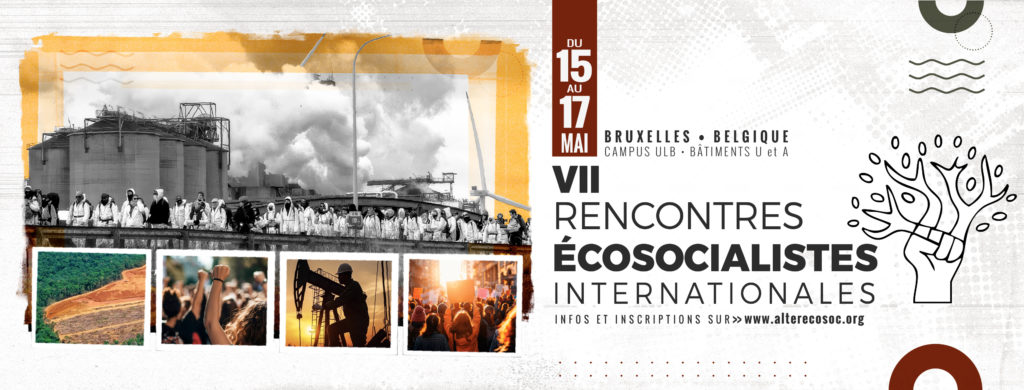
The 7th International Ecosocialist Gathering will be held in Brussels (ULB) from 15 to 17 May, 2026.
Programme
Friday, 15 May
Theme of the day:
The world of work and ecosocial transformation
13.30 – 14.30 | Plenary:
Ecosocialist trade unionism in a time of catastrophe
Íñigo Antepara (ESK, Euskal Herria),
Vincent Gay (ATTAC, France),
Edid Rocío Escobar (USO-CUT, Colombia),
Herve Kambiniam (CDT, RD Congo).
Moderation: Íñigo Antepara (ESK, Euskal Herria)
Trade unionism has been part of the Ecosocialist Meetings since their origins. This opening roundtable will present the journey so far and its importance for an ecosocialist project. Specifically, it will address progress in the convergence between trade union and ecological struggles in France, union discussions on the ecological transition in Colombia, and the impacts of increasing militarisation in the Democratic Republic of Congo. This will set out some of the themes that will be explored further in the parallel workshops.
15.00 – 16.30 | Parallel workshops | Block 1
1. Ecosocialist strategies for trade union renewal
Ilakasiri (Free Trade Union Development Centre, Sri Lanka),
Edid Rocío Escobar (USO-CUT, Colombia),
Arturo Martínez (Ecologistas en Acción, Spanish State),
Iratxe Delgado (LAB, Euskal Herria).
Moración: Ainhara Plazaola (ELA, Euskal Herria)
Workshop languages: Spanish and English.
The aim of this workshop is to share reflections and experiences regarding ecosocial transition within trade unionism. On the one hand, more and more unions are seeing the limits of a just transition strategy based on social dialogue and green growth. In a context marked by economic stagnation and trade wars, the promise of more green jobs is simply not being fulfilled. On the other hand, recent years have seen a multiplication of convergences between trade union and ecological struggles, with significant experiences developing in different countries. All this forces us to discuss effective strategies for union renewal. All these experiences are yielding valuable lessons for an ecosocialist project.
2. Struggles for ecological reconversion in industry
Bello Razaq (Michael Imoudu National Institute for Labour Studies, Nigeria),
Gregorio Mejía (USO, Colombia),
Sara López (Ecologistas en Acción, Spanish State)
Moderación: Martín Lallana (LAB, Euskal Herria)
Workshop languages: Spanish and English.
The transformation of industry plays a central role in the ecological transition. Millions of people work in sectors that must change their production in the coming decade. In this workshop we bring two experiences on the oil industry in Nigeria and Colombia, the labour situation and union conflicts associated with the energy transition. Alongside this, we will present some recent conflicts in the steel and automotive sectors in Europe. We will discuss what criteria should guide the ecosocial transformation of industry. And we will debate what trade union action, what industrial policy, and what ecological-union confluence are necessary to advance along this path.
3. Trade unions and the fight to stop militarisation
Hervé Kambiniam Salambote (Confédération Démocratique du Travail – CDT, République Démocratique du Congo),
Ansje Vanbeselaere (Intal – Stop Rearm Europe, Belgium),
Elsa Collonges (militante de la CGT),
Tayeb khouira (secrétaire national de Solidaires, France).
Moderación: Íñigo Antepara (ESK, Euskal Herria) y Juan Tortosa (solidaritéS, Suisse)
Language of the workshop: French.
Entire industrial sectors in Europe and other regions are being converted towards arms production, which implies a massive reallocation of public resources that should be destined for the ecological transition and social services. Faced with this trend, the trade union movement faces internal contradictions, but it also has a tradition of resistance to the militarisation of the economy. In this workshop we will explore specific union conflicts in countries where remilitarisation is redefining working conditions and productive priorities, and we will analyse how workers who refuse to manufacture for war are organising themselves. We will debate what position ecosocialist trade unionism should adopt in the face of rearmament, how to articulate the struggle for decent work with the demand for conversion towards socially useful productions, and what forms of international coordination are possible to halt this militarist drift.
Break
17.00 – 18.30 | Parallel workshops | Block 2
1. Care work and the migrant proletariat
Magali Verdier (CIEP-MOC Bruxelles),
A worker from Ministère du Care (Belgium),
Moderator: Iratxe Delgado (LAB, Basque Country)
In this workshop we want to turn our gaze to the struggles and conflicts in the field of care work – understood broadly: care of life, communities, territories – and to the migrant and feminised proletariat that leads these struggles. We want to do so in order to reflect on the importance and strategic character of these struggles from an eco-union perspective and to promote an ecosocialist transition. To this end, our Belgian comrades from The League of Domestic Workers and the Ministry of Care project will share their experience of struggle as care workers, many of them migrants and undocumented. Drawing inspiration from their experience, we want to create a space to share the experiences of the participants and reflect: Why and how are these struggles strategic for an ecosocialist and feminist transition? Why are we talking about this at this gathering? What challenges do we face? What are the main difficulties, risks, threats? What opportunities and strengths do we have? What alliances do we need?
2. Building alliances against green colonialism and extractivism
Felipe Gutiérrez Ríos (Observatorio Petrolero Sur y Marabunta, Argentina)
Pedro Ramiro (OMAL),
Marjorie Keters (Réseau Eco-Syndicaliste, France).
Moderación: Maureen Zelaya Paredes (People Against Extractivism)
Green colonialism refers to the dynamics of imposing “clean” energy projects by the Global North or its corporations onto the Global South and indigenous communities. The ecological transition cannot reproduce the extractivist patterns that have sustained fossil capitalism: critical mineral mining, agrofuel monocultures, or renewable energy projects imposed without community consent continue to generate dispossession, pollution, and union repression. In this workshop we will share experiences of resistance and articulation between unions, indigenous communities and territorial movements facing these projects in different contexts of the South and North. We will debate what kind of alliances are necessary for the ecological transition to be just, how the trade union movement can position itself regarding extractivism, and what frameworks of international solidarity allow progress towards a just transition with the territories.
Break
20.00– 21.30 | Opening plenary of the 7th International Ecosocialist Gathering:
Ecosocialism as a brake on capitalist catastrophe
Fatima Ouassak (author and co-founder of the Front de mères, France),
Leonidas Iza (President of ECUARUNARI, the Confederation of Kichwa Peoples of Ecuador),
Paula Delfino (member of the Marabunta Agroecological Production Cooperative, Argentina),
Mariana Riscalli (Member of the National Executive of the PSOL and Executive Director of the Lauro Campos and Marielle Franco Foundation, Brazil),
Iratxe Delgado (LAB, Euskal Herria),
Edid Rocío Escobar (USO-CUT, Colombia).
Moderator: Sébastien Brulez (Gauche anticapitaliste, Belgium)
—
Saturday, 16 May
09.00 – 10.45 | Plenary:
Geopolitics and imperialism: What is the context in which this Ecosocialist Gathering is taking place?
Kay Mann (Member of Solidarity and researcher at the University of Wisconsin, USA),
Yoletty Bracho (Université d’Avignon, Contretemps web magazine, France/Venezuela),
Artem Tidva (trade unionist, Sotsialnyi Rukh, Ukraine),
Vitaliia Kilinkarova (Degrowth expert, Sotsialnyi Rukh/Social Movement, Ukraine),
Joseph Daher (researcher and internationalist activist, Switzerland).
Moderator: Franck Gaudichaud (University of Toulouse, Contretemps web magazine, France)
All over the world, imperialist offensives, reactionary authoritarian regimes and armed conflicts are being waged with ever-greater intensity against the people, from Cuba to Ukraine, from Iran to Lebanon, from Kanaky to Palestine, via Venezuela, Mali and Sudan. Several regional and global powers are also fiercely vying for control of the world, whilst the United States is embroiled in a whirlwind of aggression and wars on all fronts. How can we make sense of the complexity of the current global chaos in order to best build our internationalist and anti-imperialist solidarity?
11.00 – 12.30 | Parallel workshops | Block 1
1. Artificial intelligence: algorithms of catastrophe and rumours of revolution
Aline Blankertz is a data economist specialising in the economics of data and platforms. She is part of the digital policy collective Structural Integrity and co-organiser of Cables of Resistance.. She previously worked on digital policy at Wikimedia Germany,
João Camargo is a climate researcher, agronomist and environmental engineer, as well as a founding member of the grassroots anti-capitalist collective Climáximo. He has worked for the Corporate Europe Observatory and as a communications officer at the European Parliament, and recently co-authored the booklet ‘Algorithms of Collapse’ with Sascha Brandsma,
Liesbeth Hondelink is a doctor specialising in pathology and a leading member of Extinction Rebellion Netherlands. She has worked professionally with AI and is a staunch critic of big tech, participating in RipplEffect’s “Algorithms of Revolution” campaign.
AI is a currently a means of production, a tool of communicative hegemony, of cultural hegemony, of mass surveillance and political persecution, a weapon for the perpetration of violence, a site of struggle and a combination of physical locations, infrastructure and connections. There are two main direct ways for non-hegemonic groups to interact with AI: to withdraw from the spheres in which AI operates (which is extremely difficult), and/or to acquire the capacity to deploy our own automation tools and even AI. What should eco-socialists do? Radical social movements dedicated to preventing the collapse of society and the planet, overthrowing capitalism and building a viable, democratic and eco-socially just future must simultaneously strip Big Tech of its power and acquire and deploy counter-hegemonic automation and AI tools.
2. The role of education in ecosocial change
Paula Delfino (member of the Agroecological Production Cooperative – Marabunta, Argentina),
Elsa Roland (Institute for Research in Teaching and Education at UNamur, Belgium)
Charo – via video link (Ecologistas en Acción, Spain).
Moderators: Valentine Fueter Ohanessian and Sébastien Bertrand
Workshop languages: French and Spanish
This workshop will focus on the role of schools in the various dimensions of eco-social transformation, as well as on the creation of tools to prevent the rise of fascism through the exchange of experiences.
3. Where is political ecology heading in Belgium?
Clara Seynaeve (SAP-Antikapitalisten/Gauche anticapitaliste)
Pierre Eyben (spokesperson for the Mouvement Demain and councillor in Liège)
Jori Dupont (independent Walloon MP)
William Donni (to be confirmed)
Moderation: Lucie Choquet (Formation Léon Lesoil)
Workshop language: French
4. Land defenders facing persecution in Latin America
Diana Vela Almeida (lecturer at the Copernicus Institute of Sustainable Development, Utrecht University, and member of the Critical Geography Collective of Ecuador),
Claudalice Santos (environmental activist, Brazil),
Leonidas Iza (President of ECUARUNARI and former President of CONAIE, Ecuador),
Juan Antonio Samper (Colombian doctoral researcher at Lund University).
Moderator: Gabriela Gallardo Lastra (postdoctoral researcher at Utrecht University and member of the BioDefenders project).
Workshop language: Spanish
The aim of this panel is to analyse the work carried out by environmental defenders from various perspectives and at different levels. It will address, on the one hand, the dynamics of persecution, criminalisation and murder of land defenders, particularly in Latin America; and, on the other, indigenous organisations as social movements, and the role of academia, NGOs and human rights organisations in documenting, denouncing and supporting these struggles.
The panel seeks to generate a critical dialogue between situated experiences of territorial defence and analytical approaches, highlighting the tensions between the limits and potential of knowledge production, political advocacy and international solidarity. The event will feature the participation of academic researchers from Utrecht University, as well as indigenous leaders from Ecuador, Brazil and Colombia, fostering a space for horizontal exchange between academic knowledge and territorial knowledge.
Break
13.30 – 15.00 | Parallel workshops | Block 2
1. Imperialism and green colonialism
Jawad Mustakbal (ATTAC – CADTM Morocco),
Fatima Ouassak (author and co-founder of the Front de mères, France),
Erika Gonzalez (OMAL, Spain),
Emma Lehbib (spokesperson for the Sahrawi Diaspora in Germany).
Moderator: Juan Tortosa (solidaritéS, Switzerland)
Workshop languages: French and Spanish
2. Ecosocialism, spirituality in resistance and liberation theology
Michael Löwy (Marxist and eco-socialist sociologist and philosopher, France),
Allan Coelho (University of São Francisco),
Fernanda Malafatti (Teacher in the São Paulo Municipal School Network).
Moderator: Luis Martínez Andrade (Catholic University of Louvain)
Workshop language: Spanish
Eco-socialism and liberation theology share some common points of reflection regarding the crisis of capitalist civilisation. On the one hand, both schools of thought denounce the exploitative dynamics of the capitalist model, in which the myth of progress plays a central role. On the other hand, both eco-socialism and liberation theology highlight the need to coordinate the struggles of peasant and indigenous peoples against the current model of development. The role of the base ecclesial communities (CEBs) and the popular pastoral ministries has been fundamental in the emergence of the most significant social movements in Latin America: the Landless Workers’ Movement (MST) in Brazil and the Zapatista National Liberation Army (EZLN) in Mexico. In opposition to the neoliberal model and agribusiness, eco-socialism and liberation theology defend use-values, family farming, the role of spirituality (or mysticism) and the decommodification of nature. Furthermore, it is important to note that social movements linked to liberation theology are characterised by being anti-capitalist, anti-colonial and anti-imperialist. This workshop aims to analyse both the theoretical and political convergences and the strategies of struggle between eco-socialism and liberation theology.
3. Debt: a brake on ecosocial transition
Pablo Laixhay (CADTM),
Scarlett (Debt for climat),
Polina Girshova (Eurodad).
Debt is now a major mechanism of economic and financial coercion and wealth transfer within the capitalist system. Whilst the urgency of the situation demands that we fight for ecological transition and social justice, the use of public debt condemns a majority of countries, mainly in the Global South, to extractivist models and the implementation of neoliberal policies that benefit corporations and capitalists, mainly in the Global North. What options and levers do we have at our disposal to halt this destructive cycle? We discuss this with three organisations specialising in the issue of debt: Eurodad, Debt for Climate and CADTM.
4. Fossil fascism: how the far right appropriates the ecological question and how to fight it
Louis Droussin (researcher in political science at the University of Namur, Belgium),
Pablo Solon (researcher and activist on socio-environmental issues, former Bolivian Ambassador to the UN and chief negotiator at the COPs from 2009 to 2011).
Modaration: Aphroditi Maravelaki (Gauche anticapitaliste, Belgium)
Workshop languages: Spanish and French
Is the far right ‘anti-environmental’… or is it, in fact, reclaiming this issue? Why does it no longer openly deny climate change, but instead increasingly attacks environmental policies? Why are figures such as Donald Trump dismantling climate regulations whilst defending fossil fuels? Which section of the population might be attracted to such a programme? Are we witnessing the emergence of a form of ‘carbofascism’, an alliance between the far right and fossil fuel capital (TotalEnergies, Shell, ExxonMobil, Chevron, BP, etc.)? And at the same time: what does this other, more subtle development signify? Why do some far-right discourses now speak of landscapes, nature, ecosystems… or present immigration as an ecological threat? Should we see this as a rise in eco-fascism?
5. The return of economic planning
Simon Hannah (Anti*Capitalist Resistance, UK),
Martín Lallana (Anticapitalistas, Spain)
Workshop languages: English and Spanish
After several decades of being dismissed as an obsolete concept, the debate on economic planning is back in the spotlight. The multiple crises we are experiencing and the markets’ inability to resolve them are fuelling this renewed interest. In this workshop, we will approach the topic from two angles. First, we will outline the central ideas of his book “Reclaiming the Future: A Beginner’s Guide to Planning the Economy”, bringing socialist discussions on planning into the present day. We will then discuss the reasons behind increased state intervention in the economy in capitalist countries and link the demands for democratic economic planning to current social, trade union and political struggles. Beyond being an abstract slogan, eco-socialist planning can serve as a focal point around which to concentrate organisational and mobilisation efforts.
Break
15.30 – 17.00 | Plenary:
In dialogue with the ideas of Michael Löwy
Michael Löwy (Marxist and eco-socialist sociologist and philosopher, France).
Moderators: Vincent Gay (ATTAC, France) and Vanessa Dourado (ATTAC Argentina)
20.00 | Party night
Let’s meet at Le Poste, in the city centre, for a night out.
Address: Place du Jeu de Balle, 62 – 1000, Brussels.
—
Sunday, 17 May
09.00 – 10.45 | Plenary:
Ecosocialism and degrowth
Daniel Tanuro (coordinator of the drafting committee for the Manifesto for an Eco-Socialist Revolution, member of the Gauche anticapitaliste, Belgium),
Julia Marti (researcher at the Observatory of Multinationals in Latin America – OMAL),
Hugo Abad Frias (Research & Degrowth International),
Marina Campos (Geography teacher, urban farmer and activist with the Education Union, activist with Centelhas – Fourth International – PSOL (Brazil), and the World March of Women).
Moderator: Christine Poupin (member of the NPA, France, and the Fourth International)
The Manifesto for an Eco-Socialist Revolution bears the subtitle ‘breaking with capitalist growth’. Reducing energy consumption—and, consequently, material production and transport—is an essential prerequisite for any project that aims to prevent the current situation of disasters from turning into a cataclysmic collapse. What does this imply for the definition of an emancipatory eco-socialist project? What breaks does it represent with respect to the socialist or communist projects that for so long represented the hopes of the exploited and oppressed? How is this global degrowth articulated in an international context that is both highly complex and highly unequal?
Break
11.00 – 12.30 : Parallel workshops
1. Agroecology and food sovereignty
Marina Campos (Geography teacher, urban farmer and activist with the Education Union, member of Centelhas – Fourth International – PSOL (Brazil), and the World March of Women),
Paula Delfino (member of the Agroecological Production Cooperative – Marabunta, Argentina)…
Moderator: Sébastien Kennes (RESAP, Belgium)
Workshop languages: Spanish and French
The aim of the workshop is to provide an overview based on the practical experience of each collective, focusing in particular on the general state of agriculture in each region, the main ways in which agribusiness and extractivism are expanding, and the current state of the agroecological movement, including its progress and challenges. It would be interesting, as part of this general exchange, for those with other agroecological experiences to present them briefly and for the discussions to generate ideas for joint actions between collectives in the Global North and South working on this theme.
2. Disruption and revolutionary strategy today
Christine Poupin (miembro del NPA, Francia, y de la IV Internacional),
Liesbeth Hondelink (XR Netherlands, Project All In).
Moderación: Antoine Larrache (Inprecor)
Workshop languages: French and English
In these days were are looking into immense disruption emanating from the capitalist system, its economic, cultural and technological structures, which are devastating the lives of the peoples of the world, nature and the climate that guaranteed the material conditions for civilisation during the millennia of human existence. Resistance isn’t enough, we need advance and disrupt this system and bring on the revolutionary plans, programs and strategies that allow us to mobilise the working class and produce the alliances and coalitions to prevent the path of collapse that capitalists have put us on. The debate will feature two recent theoretical / practical proposals for this: the IV International’s Manifesto for an Ecosocialist Revolution and Project All In, based on the book All In – A Revolutionary Theory to Stop Climate Collapse.
3. Ecofeminist convergence between Global South and North
Francisca Fernández Droguett (Iniciativa Ecosocialista, Chile),
Júlia Martí Comas (Observatori del Deute en la Globalització (ODG) y Anticapitalistas),
Gabriela Gallardo Lastra (Utrecht University).
Moderation: Vanessa Dourado (Attac Argentina)
As wars intensify and far-right movements rise across the world, patriarchal forces are pushing back against the gains of feminist and LGBTQ+ struggles—reinforcing domestic roles and deepening systems of exploitation. At the same time, extractivism continues to expand, turning territories and bodies into zones of sacrifice.
But resistance is already happening.
Across Latin America and beyond, popular and territorial feminisms are organizing around water, seeds, land, and energy—redefining care as a collective, political, and territorial practice.
This workshop creates a space to build bridges between the Global South and North, strengthening networks and collective strategies to confront capitalist, extractivist, colonial, and patriarchal systems.
4. Presentation of the Global Ecosocialist Network
Michael Löwy (sociologist and Marxist and eco-socialist philosopher, France),
Simon Hannah (Anti*Capitalist Resistance, UK),
Kay Mann (Solidarity, USA),
Mariana Riscalli (Member of the National Executive of the PSOL and Executive Director of the Lauro Campos and Marielle Franco Foundation, Brazil).
Panelists will discuss the nature and activities of the Global Ecosocialist Network, the nexus of “Trump-Deregulation-Climate Change-Neoliberalism,” and the importance of work by activists from the Global South. A sense will also be conveyed of ecosocialist struggles in Europe (with special reference to the UK), North America (with special reference to the US), and Latin America (with special reference to Brazil). The presentations will be followed by discussion involving the panelists and the general audience.
Break
13.30 – 15.00 | Plenary:
Ecosocial struggles and the prospects for an ecosocialist future
—
Practical Information
Venue for the gathering
Université libre de Bruxelles (ULB, Belgium)
Buildings A and U
Solbosch Campus
Avenue Franklin Roosevelt 50, 1050 Ixelles
Information on how to get there
https://www.ulb.be/en/maps-directions/solbosch
Registration
Registration is only possible through this form online.
Fees
Organising an international gathering like this costs money, so we ask those taking part to make a contribution according to their means.
15€ (reduced)
25€ (standard)
50€ (solidarity)
Please make your payment by bank transfer to this account «Camp 2015» BE33 0689 0161 6946
BIC code : GKCCBEBB
Please indicate in your message: Last name + first name + RIE 2026
Languages
The languages used at the gathering will be French, English and Spanish. Please indicate on the form the languages in which you can follow the debates. This will help us organise the interpreting teams.
Accommodation
We do not provide accommodation for participants. However, we will do what we can to offer solidarity accommodation, in so far as there is availability, with priority being given to those from the global south.
-> Requests can be made on the form for registration.
We are also looking for people who can offer solidarity accommodation. If you are able to do so, please also mention this on the form.
We ask all those who can to book their own accommodation. We suggest hostels as the cheapest option. There are at least four in the centre of Brussels:
Auberge de Jeunesse Génération Europe
Auberge de Jeunesse Bx Downtown
Auberge de Jeunesse Jacques Brel
Auberge Bruegel
Appeal
Below is the appeal for this 7th International Ecosocialist Encounters. Please do sign it and help us to distribute it.
See you in Brussels from 15 to 17 May!